Choose Instagram competitors that help answer a specific business question. Start with a direct peer serving a similar customer need, offer and relevant market. Add adjacent alternatives or aspirational brands only with an explicit role. Keep creative references outside the peer benchmark when their business context is substantially different.
The Instagram account comparison tool compares two public accounts. A useful first pairing is the client and one carefully chosen peer. A broader research list can live in your own selection worksheet; the method does not assume an unlimited monitoring portfolio.
Start with the customer decision
Write the decision in ordinary language: “How should we explain a weekday lunch offer?” or “Which first-visit questions should our studio answer?” Then ask which businesses customers might reasonably consider for that need. This is a stronger starting point than selecting the accounts with the largest follower counts.
Geography matters for a local service, but it may matter less for a digital product. Price, purchase frequency and service model can matter even when two accounts share a category. Record the dimensions relevant to the specific decision instead of forcing every account into a universal score.
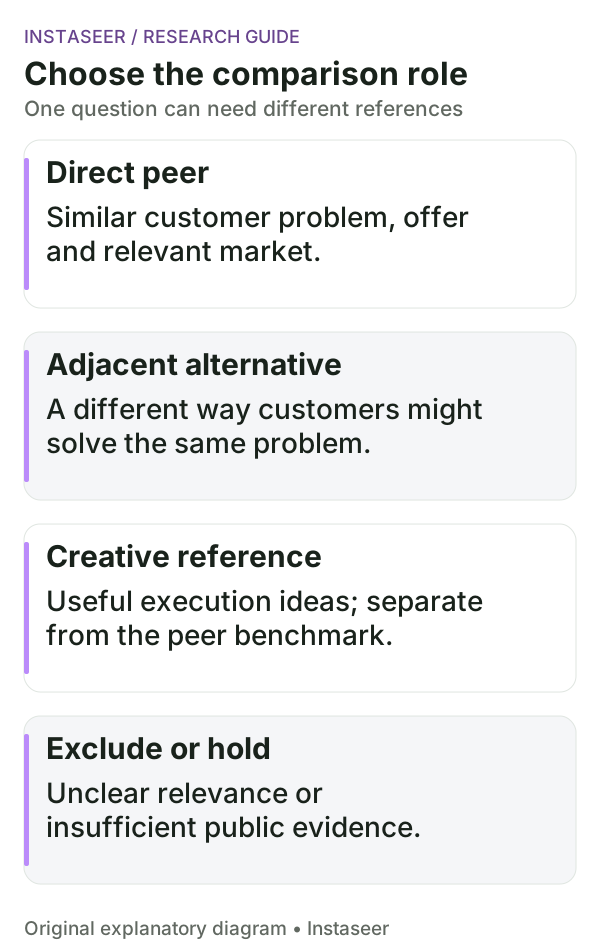
Give each account a role before collecting metrics
A direct peer has a sufficiently similar offer and customer context to support a focused comparison. An adjacent alternative competes for a related need but may require a separate analysis. A creative reference provides inspiration for how to explain or present something; it does not automatically supply a fair performance benchmark.
Keep those roles in separate columns or sections. If the client is a neighborhood café, a national coffee brand may have production resources, distribution and purchase occasions that differ greatly. Its creative can still be worth studying without treating its interaction counts as the café’s expected results.
Use an evidence-based selection matrix
Build a short candidate list from businesses the client actually encounters, public category searches and relevant source posts. Ask the client to explain known alternatives, then verify the visible offer yourself. Record uncertainty when the website or profile does not make an important detail clear.
| Candidate | Fit with decision | Research role |
|---|---|---|
| Nearby lunch café | Similar occasion, local area and walk-in offer. | Direct peer. |
| Meal-delivery service | Solves lunch, but with different convenience and purchase steps. | Adjacent alternative. |
| National coffee brand | Relevant food storytelling; different scale and offer. | Creative reference. |
| Travel creator | Appealing photography, but unclear connection to weekday lunch. | Hold unless a relevant question emerges. |
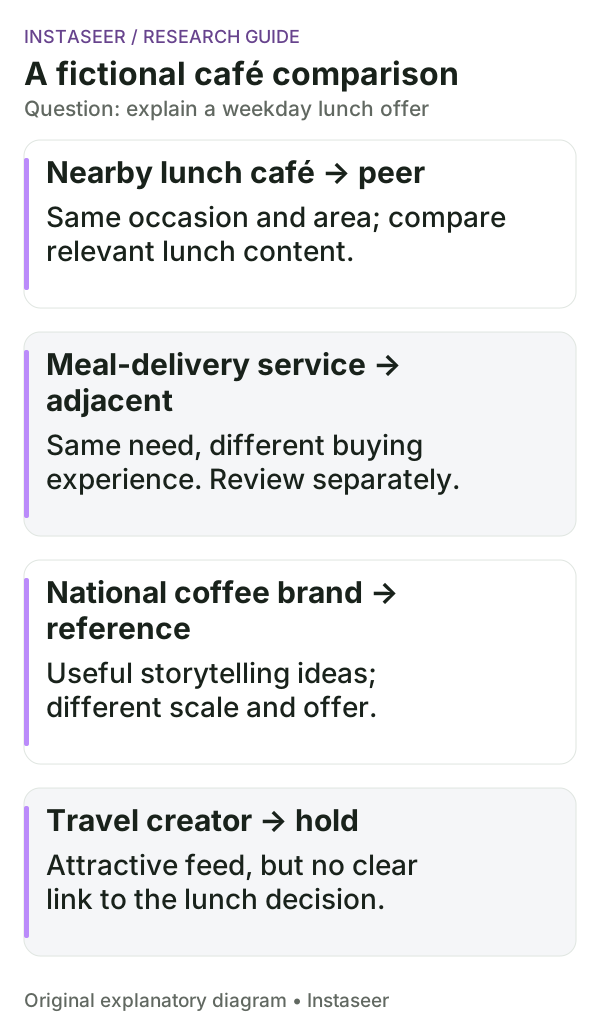
These are qualitative selection decisions, not an objective market ranking. An account can move between roles when the question changes. The travel creator might become relevant to a destination campaign, while the meal-delivery service might become the primary comparison for an ordering-flow question.
Check whether the public evidence can answer the question
Open the account and relevant source posts. Check whether the content concerns the offer you intend to study, whether publication dates overlap your window, and whether enough comparable examples are available. A strong business match with almost no relevant public content may be unsuitable for this particular content comparison.
The current Instaseer free comparison describes up to 25 returned posts per account, possible pinned content and incomplete metrics. The returned counts may differ. Keep each account’s observation date and timezone and inspect publication coverage before comparing a typical post or publishing cadence.
Do not replace a highly relevant but sparse account with an unrelated prolific account simply to make the table look complete. Mark the evidence gap, adjust the research question or add a second relevant peer in a separate comparison.
How many Instagram competitors should you track?
There is no universally correct number. For an initial two-account review, use the client and one direct peer. If the first peer leaves an important question unresolved, add another relevant peer and analyze it on the same declared basis. Keep a small reference list only while you can still inspect the source evidence and explain each account’s role.
Adding accounts increases research work and can introduce incompatible offers, windows and audiences. It does not automatically improve the conclusion. A national industry benchmark requires a different sampling design from a practical client comparison.
Reduce selection bias before naming a winner
Record the inclusion rule before looking at engagement. Otherwise it is easy to choose a weak competitor that flatters the client or an exceptional account that makes the client look unnecessarily poor. Retain excluded candidates and a short reason so another reviewer can understand the choice.
When reporting across periods, preserve the selected accounts where the decision remains the same. If a business closes, changes its offer or becomes irrelevant, explain the replacement. A different competitor set can change the summary even when the client’s content has not changed.
Account-selection note
Client question:
Candidate handle and public profile:
Relevant customer need / offer / market:
Observed evidence of that fit:
Role: direct peer / adjacent / creative reference / hold:
Relevant source posts and publication window:
Evidence gaps:
Reason for inclusion or exclusion:
Review trigger: when should this selection change?
What should you do with a competitor that has far more followers?
First decide whether its offer and customer context still make it a useful peer. A large follower difference does not invalidate every qualitative comparison, but it changes how raw interaction counts should be read. A follower-relative metric may provide additional context only when the formula and each dated denominator are explicit; it does not remove differences in distribution or audience composition.
Use the competitor report template to record the selection rationale before presenting results. The final comparison should make it easy to answer “Why these accounts?” before anyone asks which performed better.